General pest control is the plan most Treasure Valley homes actually need. Instead of calling a different company every time a new bug shows up, one recurring service keeps the whole common lineup in check: the spiders in the garage, the ants on the counter, the wasps under the eave, the box elder bugs on the south wall, and the mice looking for a way in before winter. Here is exactly what it covers, what a visit looks like, and why staying ahead of pests beats chasing them. If you would rather just talk it through, call (208) 949-5184.
What general pest control covers
The plan is built around the pests that come with living in the Treasure Valley, not a menu you have to piece together. These are the ones we treat and prevent on every home:
🕷️ Spiders
The most common pest problem in the valley. Hobo spiders, wolf spiders, black widows, and the harmless cellar spiders in the basement. We remove webs and egg sacs and treat the spots they hide. More on our spider control service.
🐜 Ants
Odorous house ants and pavement ants run the countertops and patios all summer. The trick is treating the colony, not the trail, which our ant control page explains in detail.
🐝 Wasps
Paper wasps under eaves, yellowjackets in the ground, and hornets in the trees. We clear active nests and treat the spots they like to rebuild. See our wasp control service.
🪲 Box elder bugs and beetles
Box elder bugs pile up on warm walls every fall and try to overwinter inside. We also handle the ground beetles and other beetles that wander in. Details on box elder bug control.
🦗 Earwigs and crickets
Irrigated valley yards are earwig and cricket heaven, and both push toward the house as the ground dries in late summer. Covered by earwig control and cricket control.
🐭 Rodent prevention
General service focuses on keeping mice out: sealing advice and exterior monitoring so they never settle in. An active infestation steps up to full rodent control.
If a pest is common in a valley home, the general plan is meant to handle it. When a single problem is heavy enough to need its own approach, like a colony of ants that has been budding for a season or a wasp nest in a wall void, we build that into the same visit instead of sending you elsewhere.
What a visit looks like, start to finish
A real service is more than someone walking the perimeter with a sprayer. Here is the order we work in on a general pest visit.
- Walk the property and read it Before anything gets treated, we look. Where are the webs, the ant trails, the nests, the entry gaps? Ten minutes of looking tells us which pests you have and where they are getting in, so the treatment is aimed instead of guessed.
- Knock down webs and nests by hand We brush down spider webs and egg sacs from eaves, soffits, and window frames, and we clear the wasp nests we can safely reach. Removing them by hand takes out the next generation and makes new activity easy to spot on the following visit.
- Treat the inside only where it is needed If you have an ant trail in the kitchen or spiders in a basement corner, we treat those spots directly. We do not blanket your living space. Most of the work stays outdoors, which is better for your household and still solves the problem.
- Lay the exterior barrier This is the core of the visit. We put down a treated band around the foundation and up the lower walls, plus the doors, windows, weep holes, and eaves where pests cross to get in. Every product goes down according to its label, with kids and pets in mind.
- Point out the fixable stuff and report back We flag the gaps worth sealing, the shrub touching the siding, the bad door sweep. Then you get a plain note on what we treated, what we used, and anything to do before we return.
How the exterior barrier works
The exterior barrier is the part that does the quiet, everyday work of keeping bugs out, so it is worth understanding. We use Bifen I/T, a broad-spectrum product labeled for spiders, ants, wasps, and dozens of other pests. Applied around the foundation and lower walls, it leaves a long-lasting treated band that insects have to cross when they try to enter the home. It is odorless, dries clear, and does not stain the siding or the concrete.
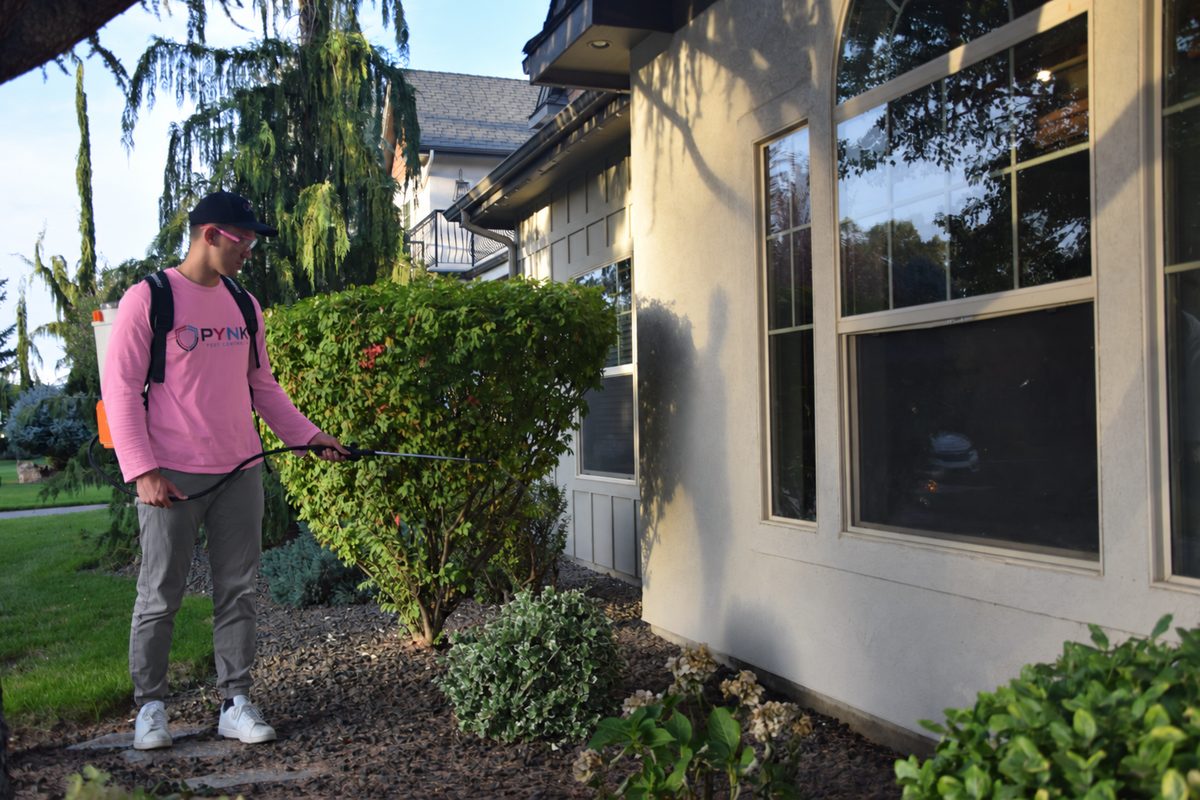
Here is the pro-level reason it matters. Almost every pest that ends up inside your house started outside and came in at ground level: along the foundation, under a door, through a weep hole, up a downspout. If you only treat the bugs you can see indoors, you are mopping the floor with the tap still running. The barrier turns the whole base of the house into a line the insects cannot cross without picking up the product. Pair that with the colony-killing, non-repellent products we use on ants and perimeter pests, and you are cutting the problem off at the source and at the door at the same time.
Why the barrier fades, and why that is normal. No exterior treatment lasts forever. Sun, sprinklers, rain, and time break it down over a few months, which is exactly why one-and-done spraying disappoints people by the next season. A barrier that is renewed on a schedule stays strong through the part of the year when pests are pushing hardest. A barrier left to weather down becomes a welcome mat again.
Why recurring beats waiting for bugs
People ask if they can just call when they see something. You can, and sometimes a one-time treatment is the right tool. But in the Treasure Valley, reactive pest control means you are always a step behind, because the pests here arrive in predictable waves tied to the seasons.
This is high desert. Everything green is green because someone waters it, so the irrigated yards, the canal network, and the farm fields at the valley edges keep insects and moisture moving through the neighborhoods spring through fall. Spiders hatch in spring. Ants and wasps build all summer. Box elder bugs and spiders surge in the fall, and the first cold nights send everything that can fit through a crack pushing toward the warmth of your house. A barrier renewed on a schedule meets each wave with a fresh treatment. A house treated once in July has almost nothing left by the time the fall invaders show up.
That is the honest case for a recurring plan. It is not that a single treatment does nothing. It is that our climate keeps producing new pests, and staying ahead of them costs less stress and less money than fighting an infestation after it settles in. Every recurring plan is backed by the same promise: if pests come back between scheduled visits, we come back at no charge, and if the problem keeps coming back, you get your money back.
The Treasure Valley pest year
Here is roughly when the common pests are active around the valley. Blue means active, pink means peak. It is the clearest argument for spreading coverage across the year instead of treating once and hoping. For the full month-by-month walkthrough, see the Treasure Valley pest calendar.
| Jan | Feb | Mar | Apr | May | Jun | Jul | Aug | Sep | Oct | Nov | Dec | |
|---|---|---|---|---|---|---|---|---|---|---|---|---|
| Spiders | ||||||||||||
| Ants | ||||||||||||
| Wasps | ||||||||||||
| Box elder bugs | ||||||||||||
| Earwigs | ||||||||||||
| Rodents (moving in) |
Get ahead of the next wave. Free quote, honest recommendation, no pressure.
Get a Free Quote →Which plan fits your home
General pest control comes in a few shapes, and we will tell you honestly which one suits your situation instead of pushing the biggest one.
- Quarterly is the standard for most homes. Four visits a year keep a fresh barrier through each season, which matches how valley pests actually behave. See how quarterly pest control works.
- Bi-monthly is for heavier or high-sensitivity situations. If you have a persistent problem, a large lot backing up to fields, or you simply want the tightest coverage, bi-monthly service visits every other month to keep the barrier at full strength year round.
- One-time treatment for a specific flare-up. Hosting an event, or dealing with a single burst of activity? A one-time treatment knocks it down, and we will be straight about what it will and will not do long term.
- New construction and move-ins. A fresh build on turned-up soil sees a lot of early activity. New-construction pest control gets ahead of it before it starts.
General pest control is the backbone of both our residential and commercial service. Pricing depends on your home's size and how established the problem is, and you always get the exact number before any work happens. See plans and pricing, and remember your first service is $50 off.
What you can handle yourself
We are a pest control company telling you how to need us less. These steps genuinely cut down on pests, and they make every treatment last longer.
- Seal the obvious gaps. A worn garage door sweep, gaps around utility lines, and torn window screens are the busiest entrances on most valley homes. A tube of caulk goes a long way.
- Pull mulch, rock, and firewood back off the foundation. Damp cover right against the house is where earwigs, spiders, and widows set up. A few inches of clearance changes the odds.
- Trim shrubs and branches off the siding. Anything touching the house is a bridge that walks pests right over the barrier.
- Swap bright white porch bulbs for warm yellow LEDs. White light pulls in the night insects that spiders and other predators follow. Fewer bugs at the light means fewer at the door.
- Fix the moisture. Point sprinklers away from the foundation, clear the gutters, and dry up the standing water. Most valley pests are chasing water as much as food.
Do all of that and still see steady activity, and the population around your home is big enough that a treatment plan will earn its keep.
Common questions
What does a general pest control plan cover?
It covers the common household pests in one recurring service: spiders, ants, wasps, box elder bugs, beetles, earwigs, crickets, and everyday nuisance insects, plus rodent prevention around the outside of the home. We treat the pests you have now and put down a barrier to slow the next wave. If a specific problem like a heavy ant or wasp job needs extra attention, we fold that into the same visit.
Do you treat inside the house or just the outside?
Both, but most of the work happens outside. The exterior barrier around your foundation and lower walls is what stops pests before they get in, so that is where we focus. Inside, we treat only where you are seeing activity, like a kitchen ant trail or spiders in a basement corner. Keeping most of the product outdoors is better for your household and still handles the problem.
How is general pest control different from calling for one specific pest?
A general plan covers the whole mix of common pests at once instead of one at a time. Treasure Valley homes rarely have only spiders or only ants. The same conditions that bring one pest bring several, so treating everything on one recurring visit usually costs less and works better than booking separate one-off jobs. If you have a single stubborn pest, we still build the visit around it.
Do I need to be home for the treatment?
No, not for the exterior service. Most of our work is around the outside of the home, so we can treat the perimeter, knock down webs and nests, and check entry points without anyone there. If you want interior work done, we schedule that for a time that suits you. Either way, you get a note explaining what we treated and any steps to follow afterward.
How long before the bugs are gone after the first visit?
You usually see a sharp drop within a few days. The knockdown products work fast on the pests already active, while the barrier keeps building over the following weeks as pests cross the treated band. Colony pests like ants can take a little longer, because the goal is to reach the whole nest rather than the few workers on your counter. If activity lingers, we come back.